
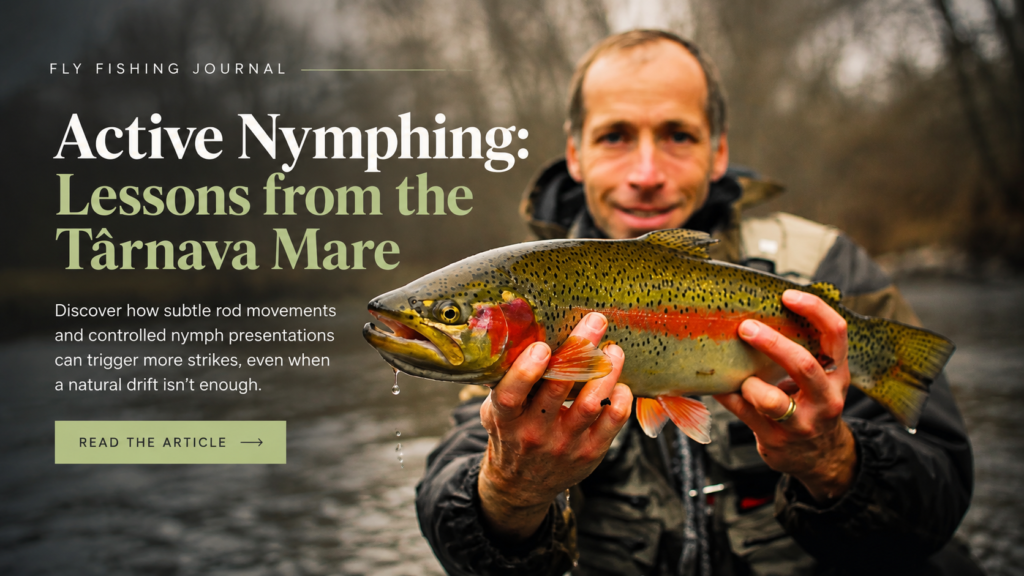
Fly fishing is a continuous learning process. No two rivers are exactly alike, and even familiar waters can surprise us with changing conditions and unexpected fish behaviour.
Over the years, fishing rivers across Romania, Slovakia and Poland has taught me one important lesson: there is no universal approach to successful nymph fishing.
One technique that has consistently produced interesting results for me involves adding controlled movement to the nymph rather than relying entirely on a natural drift.
When a Natural Drift Isn’t Enough
Traditional nymph fishing often focuses on getting the fly close to the riverbed and allowing it to drift naturally with the current.
While this approach can be extremely effective, there are situations when fish respond better to a more active presentation.
On the Târnava Mare River in Romania, I experimented with a technique inspired by jig fishing, introducing subtle vertical movements during the drift.
The results were surprisingly effective.
Bringing Your Nymph to Life
The principle is simple.
Instead of allowing the nymph to drift completely passively, gently raise and lower the rod tip as the fly moves downstream.
These movements create a slightly irregular, sawtooth-like trajectory.
The key is variation. Experiment with different lifting speeds, pauses and dropping movements.
Avoid repeating exactly the same rhythm throughout the drift. Fish behaviour changes, and sometimes a small adjustment makes all the difference.
The Importance of the Drop
One of my most interesting observations was that many strikes occurred during the descending movement of the nymph.
As the fly begins to sink after being lifted, its movement can trigger a reaction from nearby fish.
This is why maintaining contact with the fly is essential.
Pay particular attention to the moments immediately following each lift. A slight hesitation or change in tension may indicate a take.
Choosing the Right Nymph
Successful active nymphing also depends on choosing a fly that works naturally in the available water conditions.
Weight, size, shape and colour all influence the presentation.
A properly weighted nymph should reach the desired depth while remaining responsive to subtle movements of the rod tip.
Observing the riverbed and its dominant colours can also provide useful clues when selecting fly patterns.
Experience Is the Best Teacher
From grayling to brown trout and rainbow trout, I have seen different species respond positively to this active style of nymph presentation.
Of course, no technique works everywhere.
Water depth, current speed, fish activity and seasonal conditions all influence the results.
The most valuable skill an angler can develop is the ability to observe, experiment and adapt.
Sometimes the difference between an unsuccessful drift and a successful one is nothing more than a subtle movement of the rod tip.
Tight lines!
Gal Zsolt – Fly Fishing Dedicated
